


Artificial Intelligence is fundamentally reshaping several industries, especially marketing and advertising. AI-assisted creative direction and production have accelerated marketing execution, forcing leaders to make faster high-stakes decisions across the board. Teams used to have months to plan a campaign, test it, and report results; now they have hours.
Pomo aims to solve this “decision gap” with an automated system that supports marketing teams instead of replacing them. The company’s solution continuously monitors the main marketing priorities for each day, such as competitor moves, demand signals, creative trends, and channel performance. It then recommends specific actions and automates execution with team-defined guardrails.
“We didn’t build another point solution or SaaS copilot with AI bolted on. We built the whole thing in a single closed loop. Put in your URL. Pomo assesses your brand, market landscape, and market. Analysis that would take weeks, in minutes. Then it generates what you need: competitive positioning, campaign strategies, creative direction.” said co-founder Praneet Dutta.
Dutta and his co-founder Joe Cheuk have experience working at Google, DeepMind, Meta and Databricks. The pair have spent nearly a decade shipping AI into products used by hundreds of millions of people.
“We met as new grads at Google almost a decade ago, incubated projects, co-authored research and had an unspoken agreement: someday we’d build a company. Neither of us expected to end up in marketing. But the more we dug in, the clearer the problem became.” Praneet said in an interview.
According to the founders, before they launched Pomo, they pointed it at themselves. They gave it $60 in ad spend and one campaign. Twenty-four hours later Pomo was able to secure 100 signups at 17% CTR; a penny per click. With this validation, the founders released Pomo with a $58 per month subscription with higher-priced tiers that offer more services, such as the ability for an agency to manage multiple brands’ ad performance simultaneously.
Now Pomo has announced that it has raised $4.5M in Seed funding. The round was led by Kindred Ventures, with participation from Databricks Ventures, Seven Stars, SV Angel, Timeless Partners, 645 Ventures and angels including Scott Belsky, Mehdi Ghissassi, and Massimo Mascaro. The company intends to use the funds to expand operations and development efforts.
Check out the 13-slide pitch deck Pomo used to secure the $4.5 million Seed funding round.
What were the slides in the Pomo pitch deck?
Browse the exact example slides from the pitch deck that Pomo used to raise $4.5M from Kindred Ventures.
1. Value Proposition Slide
It’s easier to create a SaaS than setting up a lemonade stand nowadays, thanks to AI-assisted app development (aka Vibe coding) lowering barriers-to-entry. This has created an explosion of new startups that just about anyone can build. In fact, 25% of the YCombinator W25 batch have almost all of their codebases generated by AI. Recently, a 6-month-old, solo-owned vibe coded Base44 was sold to Wix for $80M.
This might be good news from a founders’ perspective, but for investors, this explosion has necessitated an extra layer of due diligence. They’re now dealing with far more startups than before, which means more noise to sift through. On top of that, they need to dig deeper to figure out whether there’s a genuinely useful product underneath, or just something that was quick to build but hard to justify.
Pomo’s value proposition slide argues that Pomo isn’t just another SaaS tool; it actually fundamentally improves how marketing campaigns are planned, tested, evaluated, and reported. This is important because investors don’t just want to hear what your product can do. They want to understand how your product improves the current process.
On the design side, this slide is disappointing. There’s a huge visual disconnect between the ‘As is’ and Pomo sections. The gradient under the Pomo section is unnecessary and creates imbalance rather than a clean side-by-side comparison. Additionally, statements like “Growth limited by ambition” sound more like marketing fluff than something meaningful. Instead, a better approach would be to get specific and show how Pomo actually improves efficiency.

2. Why Us Slide
Investors love getting pitched by bright young kids, usually straight out of college, with incredible enthusiasm and drive. They love the crazy world changing ideas about solving loneliness, turning waste into gold, or fixing the broken health care system. These are a lot more fun than yet another boring pitch by an experienced founder about an improved tax compliance solution for SMEs. But when all is said and done, the investors will go for the tax compliance and automation solution.
This is because even if a young founder has a great idea, they are likely to fail in execution. They might not understand the difference between prototype software that might work under controlled conditions and commercial-quality software that can’t fail. They might not realize what customers really need, what they’ll pay for, or what will convince them to buy it. Can they wear all the different hats required of a startup founder? Can they build a product themselves on a shoestring budget? Most can’t, so they raise a lot of money and burn through it quickly by hiring a big staff.
Pomo pitch deck’s “Why us” slide tries to convince investors that although Praneet and Joe are first-time founders and they have big ideas, they have the strong technical expertise and real-world industry experience to make Pomo a success. To prove this, the slide highlights the tools the founders previously built, the research they’ve published, and the success they’ve achieved.
However, just like the Value Proposition Slide, the design doesn’t quite keep up. The headline, while strong, feels disconnected from everything else on the slide. The collage of screenshots, papers, product pages, and social posts creates visual noise, making it hard to quickly scan through everything. Overall, while the direction is correct, the slide could be improved by simplifying and streamlining the design.

3. Ask Slide
For founders, the whole fundraising process as well as the pitch deck ultimately builds toward one moment: the critical ‘Ask Slide’. You’ll need to figure out how much cash you need to raise in this round to propel your company forward for the next 12–18 months until the next funding round. You’ll also need to figure out what skills, expertise, and support your business needs to be able to achieve your goals.
One mistake we often see founders make is instead of being direct and specific such as:
“We’re raising $1 million to grow from $5K to $15K users over the next 6 months”
they say vague statements like:
“Looking for strategic partners and support to grow.”
Investors don’t appreciate this as they’re trying to understand exactly what their money is going toward. Ambiguity here raises more questions than confidence.
Pomo pitch deck’s Ask slide also falls under this category. Although it breaks down the investment across various needs, it doesn’t provide any specific roadmap, doesn’t explain why founders need this exact amount, and provides no timeline for what the money will achieve. Additionally, statements like “Establishing a foundation for rapid growth” doesn’t mean anything in terms of milestones.
The slide’s design is underwhelming too. There’s no visual hierarchy, structure, or something that draws your attention to the key points. The text is bland and there’s too much empty space. Overall, the slide could be improved by breaking down the $3 million raise to specific milestones and using visual aids like charts and timelines.

How to create your own pitch deck like Pomo:
We hope you learned something from the Pomo pitch deck, and that you are able to use these insights for your own business. If you’d like to, you can bookmark it at bestpitchdeck.com/Pomo.
Although it probably goes without saying that having a successful business (outside just their pitch deck) was integral to their success, the perfect pitch deck is critical for any startup to ensure your vision is portrayed properly. That’s where crafting the perfect pitch deck comes essential:
You might find our other resources on how-to create a pitch deck helpful, or benefit from using one of our expert-designed templates:
Our team has helped create decks that have closed over $2B+ in deals & funding for leading startups and even VC firms. You can leverage this experience and get a jumpstart on your pitch with one of our easy-to-use presentation templates, one-pagers, or financial models.
Creating a deck? Check out our pitch deck templates.
Every pitch requires a unique approach tailored to its audience. Our team of experts has created pitch decks for different industries, as well as funding stages:
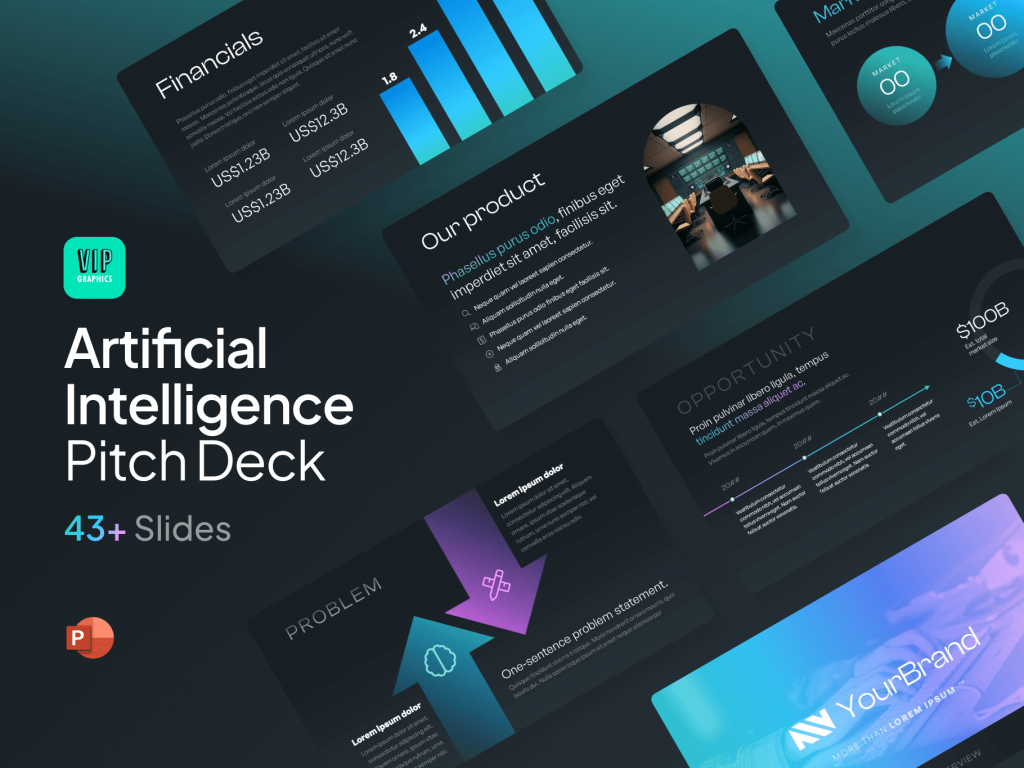
You might be interested in the popular AI Startup Pitch Deck Template designed by our team of experts at VIP.graphics. This investor presentation template is built specifically for AI startups seeking to raise funding.

Accelerator Pitch Deck Template — The Accelerator Pitch Deck template was crafted for early-stage founders seeking to win funding &/or investment from pitch contests, accelerators, incubators, and angels or VC firms. Winning a pitch contest or being accepted to a prominent accelerator program requires a unique strategic approach to an investor pitch presentation.
Series A Pitch Deck Template — A pitch deck template for startups and founders raising funding: Smart, actionable slides that work. This is a pitch deck template built specifically for startups, entrepreneurs and founders raising their first seed or Series A round of institutional capital.
Mergers & Acquisitions Pitch Deck Template — Perfect Pitch Deck™ is a template crafted for later-stage businesses entering more sophisticated discussions such as mergers & acquisitions (M&A), late-stage investment (Series C+), or other partnerships & financing opportunities. Our team of experts created this presentation to empower founders to present with confidence to investment banks, private equity (PE) groups, and/or hedge funds (and vice versa).
Alternatively, feel free to browse our growing selection of pitch decks tailored for specific industries and businesses.