


George Cheng, Dylan Nguyen, and Natnael Kahssay started Code Four inside their dorm rooms at MIT and dropped out to continue building the next generation of police tech. The platform uses advanced computer vision and natural language processing to automatically transcribe body camera footage, generate incident reports, and manage digital evidence. This reduces report writing time, allowing officers to spend more time serving their communities.
“Public safety and the government space is always kind of behind the curve in terms of getting the latest technology, even though these folks are some of the hardest working and most passionate about their mission,” Nguyen said.
To fill this gap, Code Four offers real-time transcription & summarization making every body-cam or interview video searchable text and key-frame timelines. It also allows one-click redaction of faces, plates, and minors’ voices with CJIS-compliant logs. Investigators can ask questions like “show me every time suspect #42 handled a weapon” and jump straight to the frames.
“It’s (Code Four) about reimagining what public safety can be when we apply technology thoughtfully and ethically. It’s about giving officers the tools they need to be the protectors they aspired to be when they first put on the badge.” the company said in a statement.
According to Cheng, Code Four works with 25 police departments and makes money via a subscription model, which starts at $30 per officer a month. The company has also raised $2.7 million in seed funding. The round was co-led by AME Cloud Ventures and Webb Investment Network, with participation from Y Combinator, Blast VC, CRV, E14, Halo Labs, ISeed Ventures, Nivesha Ventures, Pathlight Ventures, Unpopular Ventures, Venrex, and strategic angel investors.
“This funding is just the beginning,” said George Cheng. “We’re building technology that will define the next decade of public safety. When officers have the right tools, communities are safer. That’s what drives us every day.”
Check out the 7-slide pitch deck Code Four used to secure the $2.7 million Seed funding.
What were the slides in the Code Four pitch deck?
Browse the exact example slides from the pitch deck that Code Four used to raise $2.7M from AME Cloud Ventures.
1. Team Slide
In an era with seemingly unlimited access to capital, AI-innovations that shrink traditional technical moats, and lower switching costs, an early-stage startup’s only truly sustainable edge is its team. As Mark Zuckerberg said, “The most important thing for you as an entrepreneur trying to build something is, you need to build a really good team. And that’s what I spend all my time on.”
This is why early-stage investors put so much emphasis on the importance of the team; when choosing to invest, they focus on their assessments of the startup’s team more than the product itself.
Code Four clearly understands the importance of team strength in an early-stage pitch, which is why the founders introduce their team right at the start of the deck. For startups that haven’t already gained traction but have a highly capable founding team, this is exactly the right approach. The slide also does a great job of spotlighting the founders’ academic achievements and their hands-on experience working with police departments. The use of the word “dropout” in the heading is a clever touch as it subtly signals that George and Dylan walked away from strong academic paths at MIT to focus fully on building Code Four. That kind of conviction is something investors pay close attention to.
On the design side, the slide is clean with strong symmetry and clear hierarchy, which makes it easy to scan at one glance. The font is modern, matching the tech startup’s aesthetic, and the high contrast of the slide makes it easily readable. Overall, the slide is strong in structure, has convincing content, and is visually cohesive.

2. Ask Slide
The purpose of the ask slide is to explain how much you are raising, why you are raising, and what you expect to achieve with that capital over a given period of time. Oftentimes in pitch decks, we find ask slides that feel like a throwaway, but in fact, this is where the rubber meets the road. The ask slide is your moment to clearly state what you need and why you need it.
Before you can create the ask slide, you need to have a specific number in mind based on solid projections. For most early-stage startups, it’s usually raising enough capital to hit the metrics that will unlock the next round of funding. Having clear funding goals will show investors that you’ve thought beyond just getting the money into how this funding fits into your growth strategy.
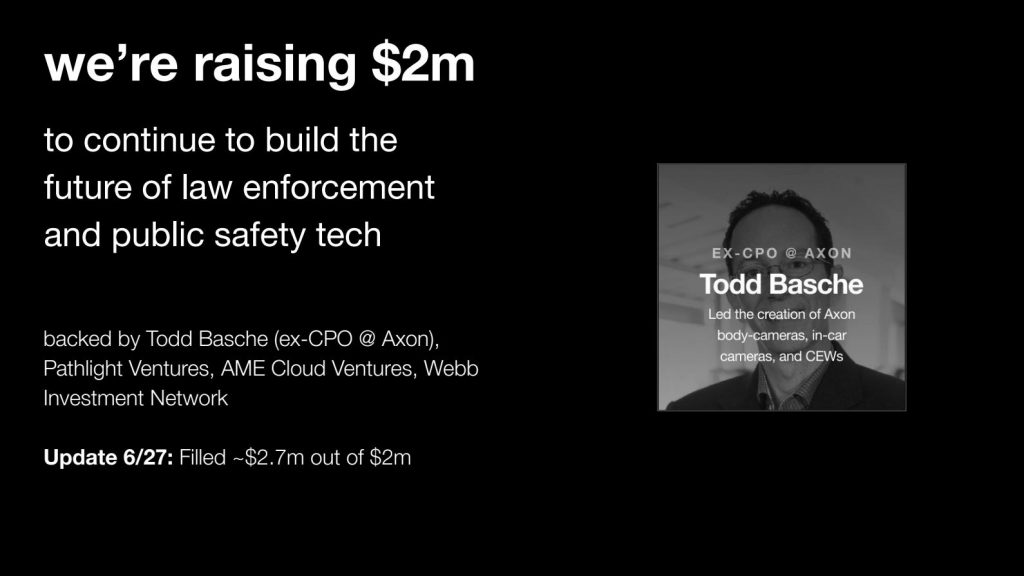
One way to present that is by breaking down the use of funds into categories (eg. $1m to product, $1m to marketing). You can also add the quarterly breakdown of the real-life milestones you intend to achieve with the capital. Sadly, we don’t find any breakdown in the Code Four pitch deck’s ask slide. Instead, the slide’s main message is “other people have invested in us, so you should too.” This doesn’t show potential future investors Code Four’s actual plan for the funding they receive.
The lack of a clear use-of-funds breakdown / milestone roadmap creates a slide that is visually pleasing, but ultimately unremarkable. Simplistic aesthetics never hurt, but investors are looking for answers and clarity. Additionally, the photo of the ex-CPO of Axon, feels out of place and competes with the core message instead of supporting it. Overall, Code Four’s ask slide fails to convey the financial logic and execution plan for the raise.
3. Traction Slide
Traction can be a source of frustration for early-stage founders when it comes to raising funds. You can check off any number of production milestones, like creating a good product, early testing, and improving your product, but a startup’s traction is what proves to investors that they need to jump on board while you are gaining momentum. It’s the same old Catch 22; you need a job to get experience, but you need experience to get a job. In this case, founders need traction to get funding, but they need funding to gain traction.
Instead, startup founders need to understand and reframe what traction means in the context of very early-stage startups. It’s not about showing revenue figures, customer signups, or recurring revenue— it’s about forward movement in the right direction. Investors want to see that you’re making progress and pushing forward.
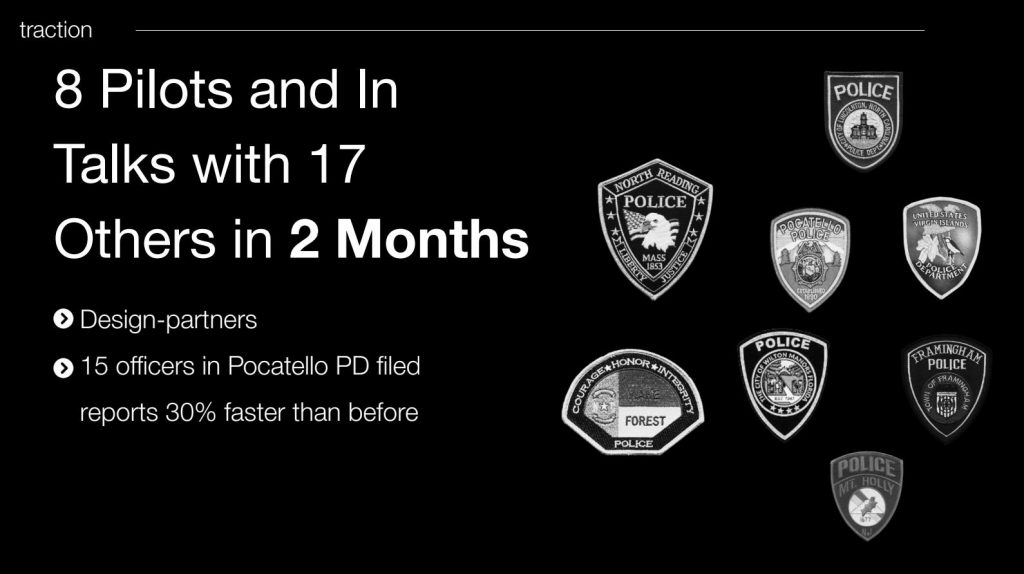
Code Four’s traction slide does a great job showcasing the forward movement instead of customer or revenue figures. This includes dozens of trails with various police stations and potential customers. The big headline ‘8 Pilots and in Talks With 17 Others’ instantly communicates momentum, and the police department badges create immediate visual legitimacy. The generous whitespace makes the slide feel clean and uncluttered. However, the slide could be improved by properly arranging the police badges instead of in an irregular, loosely spaced cluster.
How to create your own pitch deck like Code Four:
We hope you learned something from the Code Four pitch deck, and that you are able to use these insights for your own business. If you’d like to, you can bookmark it at bestpitchdeck.com/Code-Four.
Although it probably goes without saying that having a successful business (outside just their pitch deck) was integral to their success, the perfect pitch deck is critical for any startup to ensure your vision is portrayed properly. That’s where crafting the perfect pitch deck comes essential:
You might find our other resources on how-to create a pitch deck helpful, or benefit from using one of our expert-designed templates:
Our team has helped create decks that have closed over $2B+ in deals & funding for leading startups and even VC firms. You can leverage this experience and get a jumpstart on your pitch with one of our easy-to-use presentation templates, one-pagers, or financial models.
Creating a deck? Check out our pitch deck templates.
Every pitch requires a unique approach tailored to its audience. Our team of experts has created pitch decks for different industries, as well as funding stages:

You might be interested in the popular Cybersecurity Pitch Deck Template designed by our team of experts at VIP.graphics. This investor presentation template is built specifically for Security tech startups seeking to raise funding.

Accelerator Pitch Deck Template — The Accelerator Pitch Deck template was crafted for early-stage founders seeking to win funding &/or investment from pitch contests, accelerators, incubators, and angels or VC firms. Winning a pitch contest or being accepted to a prominent accelerator program requires a unique strategic approach to an investor pitch presentation.

Series A Pitch Deck Template — A pitch deck template for startups and founders raising funding: Smart, actionable slides that work. This is a pitch deck template built specifically for startups, entrepreneurs and founders raising their first seed or Series A round of institutional capital.
Mergers & Acquisitions Pitch Deck Template — Perfect Pitch Deck™ is a template crafted for later-stage businesses entering more sophisticated discussions such as mergers & acquisitions (M&A), late-stage investment (Series C+), or other partnerships & financing opportunities. Our team of experts created this presentation to empower founders to present with confidence to investment banks, private equity (PE) groups, and/or hedge funds (and vice versa).
Alternatively, feel free to browse our growing selection of pitch decks tailored for specific industries and businesses.